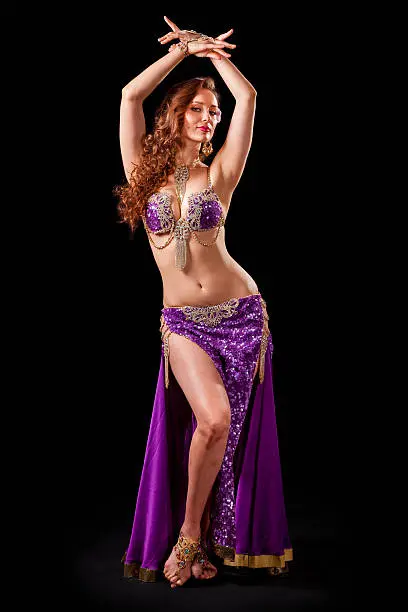
An "Arabian belly dancer" (known as
Raqs Sharqi) is a performer of a Middle Eastern and North African dance characterized by complex isolations and movements of the hips and torso. The dance originated in Egypt and has many regional styles, costumes, and music variations. While historically sometimes seen as a sensual or even forbidden art, it is now a popular form of artistic expression, fitness, and cultural celebration for many, with modern styles incorporating other influences.
Dance style and movement
- Isolations: The dance emphasizes the dancer's control over segmented muscle groups, particularly in the torso and hips.
- Torso and hip focus: Movements primarily involve circular and fluid motions of the hips and torso, differing from linear motions typical in Western dance.
- Regional variations: Styles differ across regions, with Egyptian styles being the most globally recognized due to Egyptian cinema.
- Folk styles: A more grounded, folk style called Raqs Baladi is more stationary and focuses heavily on hip movements, often performed to folk music.
Costumes
- Traditional attire: Costumes often leave the belly uncovered, though traditional folk styles may involve long, modest dresses.
- Folk and modern differences: Modern costumes, particularly those popularized by cinema, often consist of a two-piece outfit with a bra-like top and a skirt or pants, while folk styles like Raqs Baladi use a long, loose dress.
- Accessories: Dancers may use accessories such as a headscarf, a hip scarf with coins, or a cane (assaya) in some styles.
- Cultural and social context
- Historical role: Belly dancing has played a role in ancient temple rituals, entertainment, and is a staple in classic Egyptian cinema.
- Modern perception: In some modern Arab societies, the dance can still be controversial due to cultural stigma, while in others, it is a celebrated part of social and family gatherings like weddings.
- Global popularity: The dance has gained global popularity and is taught in schools around the world, with styles like American Tribal Style incorporating other dance forms.
- Empowerment: Many women view it as a form of empowerment and self-expression.